

Hi NoGoodies,
Welcome to NoGood News, your bi-weekly pulse on all things growth. We break down successful brand campaigns, provide you with the best guides for all things growth marketing, and share emerging trends and insights to keep you ahead of the curve. Plus, exclusive interviews with some of the best in the game.
Here's a quick TL;DR of what's below:
OpenAI x Pinterest acquisition: OpenAI has their eyes on one thing in 2026 and that’s Pinterest — specifically their database. But with users already frustrated with Pinterest’s latest AI features, it raises a question as to whether they will continue to stay on the platform or flock to another once the acquisition happens… if Pinterest approves.
The future of organic social: Authenticity is out, transparency is in. From starting a branded content series to the rise of intellectual influencers, 2026 becomes the year for storytelling and knowledge. But there’s still more to explore and the year just started.
AI companies tap into brand identity: Hot take or normal take — the AI industry is becoming oversaturated? If almost every AI platform boasts about its tech, efficiency, and time-saving capabilities, how can users figure out which LLM is best fit for their lifestyle? This is where AI companies start to sell a brand identity.
Ready? Let's get into it.
📌 OpenAI x Pinterest acquisition
Why OpenAI acquiring Pinterest makes more sense than you think


OpenAI might place a bet on their biggest acquisition yet – Pinterest.
OpenAI plans to leverage Pinterest’s database to compete against giants like Amazon and Google. But why Pinterest? Because they’d rather work alongside them than compete with them.
Pinterest recently rolled out AI-powered tools like conversational search and AI pins – elements that are great sources for training AI models. There are three features OpenAI has their eyes on: images, search, and commerce.
With over 200 billion images intentionally labeled, it becomes a goldmine for training AI on how people browse and search. But remember when someone leaked ChatGPT ads?
Pinterest has a monetized ad platform optimized for search-driven shopping that OpenAI doesn’t have yet, and this just may be a necessary step for them to complete that vision. Pinterest also connects people to merchants, an edge in commerce that OpenAI has only recently started tapping into.
Essentially, Pinterest would give OpenAI access to all the tools they need to understand human search behavior better and sell users products. But Pinterest still has a choice: to accept or reject the acquisition.
User sentiment online hasn’t been positive, with people expressing their concerns about this offer (especially those already frustrated with Pinterest’s AI pins). With the marketing trend of Anti-AI labels rising, Pinterest could either approve or deny this offer to solidify their stance on AI.
This acquisition would be a strategic move for OpenAI, but it risks alienating a user base that values Pinterest because it feels different from other platforms.
What are your thoughts on the potential OpenAI x Pinterest acquisition?
📱 The future of organic social
Predictions for the biggest shifts in organic social in 2026
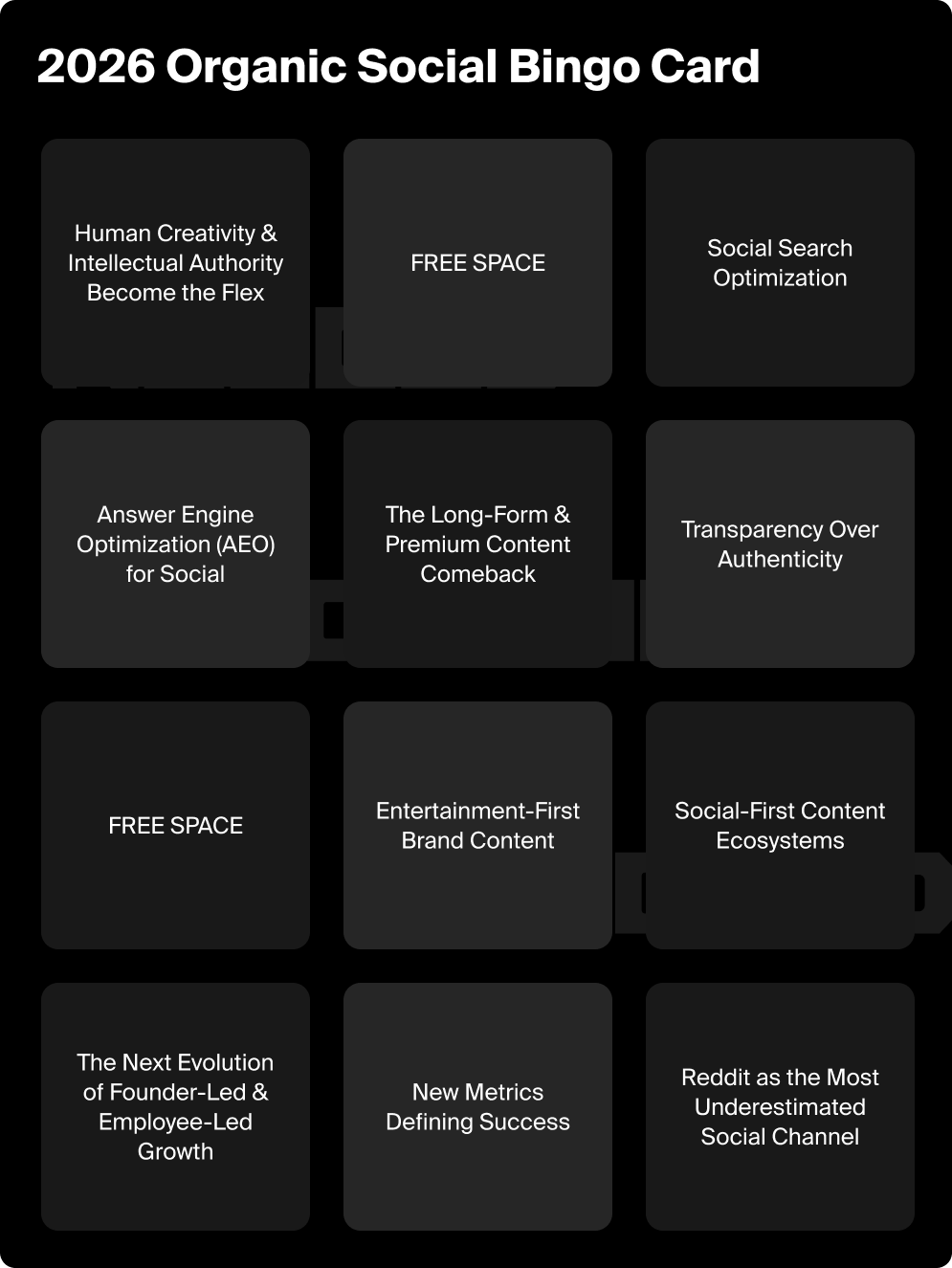
In late 2024, we predicted that 2025’s biggest shifts in organic social would center around reactive social listening, employee-generated content (EGC), and outbound community engagement. We were right… but the year delivered even more than we anticipated.
10 organic social trend predictions for 2026
Taste becomes the flex: The more AI accelerates creation, the more value concentrates in what AI can’t replicate: original taste, intellectual depth, human judgment. Anti-AI labels will start appearing on content the way “organic” and “handmade” do on products to signal luxury.
Social search optimization: Users already treat social platforms like search engines, so platforms are responding by releasing features that let creators see search insights, optimize for discoverability, and treat their profiles like landing pages. Social search will only continue to grow in 2026.
AEO for social: If social search optimizes for humans, AEO optimizes for AI engines. The distinction matters because AI tools are increasingly crawling and citing social posts, particularly on platforms like Reddit and YouTube. Brands need to think about how their content shows up when AI synthesizes answers.
Premium content comeback: Long-form storytelling (cinematic social films, episodic series, podcasts, essay-length posts) earns sustained attention precisely because it’s rare. Substack continues its rise as brands realize owned editorial properties give them leverage that rented attention on social platforms never will.
Transparency over authenticity: The trust equation has changed. Over the years, “authenticity” became a buzzword that brands co-opted until it lost all meaning. Transparency is harder to fake. Audiences have developed an emotional radar for what’s real versus what’s performed.
🤖 AI companies tap into brand identity
How AI companies are turning tools into lifestyle products

That shift from caring about AI capabilities to caring about identity is rewriting everything about how AI companies approach marketing and building communities. When users are grappling with decision fatigue and (in the case of AI at large) philosophical and existential anxiety, brand becomes the biggest tie breaker.
AI branding in three acts
The Feature Race (2022-2023): ChatGPT launched in November 2022 and broke the internet: 1 million users in five days. Every week brought a new model, a new benchmark, a new “this changes everything” moment. In other words, marketing was product velocity, while branding was an afterthought. This worked because earlier audiences cared about what the technology could do. The answers about technical specs were enough, because the audience was among the innovators and early adopters.
The First Efforts (2024-early 2025): Early 2025 was the year AI companies realized they weren’t just competing with each other anymore; they were competing with people’s fear, confusion, and decision paralysis. The early adopters had already signed up. But the next cohort on the adoption curve chose based on ~vibe~. They picked the AI that felt right, not the one with the best specs. And “felt right” meant something specific: safe, accessible, proven, permissible.
The Identity Wars (late 2025+): By mid-2025, AI companies figured out what the early majority actually needed; not just better benchmarks or feature announcements, but mental and emotional frameworks. AI adoption was becoming inevitable, but how to adopt it in a personal(ized) way wasn’t as obvious. The pivot had two parts: make it feel human, and give people a clear framework to understand what kind of AI user each of them is, or could be.
Build your AI search strategy beyond SEO
Nearly 60% of people use AI tools to influence their purchasing decisions.
That’s why maintaining brand visibility is more important than ever for organic success.
Join NoGood’s CEO, Mostafa ElBermawy, January 12th at 12PM EST for a FREE lightning course on how to build your AI search strategy beyond SEO.
Learn how to make your brand visible in ChatGPT, Perplexity, and Google’s AI Overviews before your competitors do.
🎙️ Q&A with an expert
A bi-weekly interview series with the best in the game

Q: As AI capabilities evolve, will brand identity become more important or less important?
A: Way more important.
The tech is groundbreaking, as we are reminded with every single “revolutionary” release or product update, but the pattern I see (and am frankly more excited about) is this: as people get more educated about AI — as they understand what these models actually can and can’t do, embrace it willingly or against their will — they stop making decisions based on “which one is best” and start making decisions based on “which one feels best to me.” It’s the same shift you see in any maturing category. Early adopters care about specs. But once the early majority shows up and everyone can do the same core tasks with roughly the same quality, people start choosing based on aspiration. Which identity do I want to step into? What does using this say about who I am, or who I’m trying to become?
That’s why OpenAI holds the mass appeal crown, Anthropic carved out intellectual territory, and Gemini just absorbed into (and elevated) Google’s ecosystem. When the technology underneath keeps converging, that story becomes the entire differentiator.
Q: You identified three acts of AI branding. Do you have any predictions as to what will happen after Act III: The Identity Wars?
A: I think the identities fragment, and hard.
As the market gets more saturated and AI becomes genuinely commonplace, those broad frameworks between the most prominent players (ChatGPT vs. Claude vs. Perplexity vs. Gemini, and that’s not even counting Grok, DeepSeek, Qwen, and more) won’t be enough. Brands will get hyper-niche because they’ll have to.
And here’s a bit of a hot take: people won’t pick just one identity; they will be free to contain multiple identities at once, based on the context and the need — a lesson we have learned with Gen Z’s shapeshifter approach to their self, especially in contrast to more crystallized millennial and Gen X identities.
We’re heading into an era of multi-hyphenate AI users where someone might use ChatGPT for quick everyday tasks, Claude for deep thinking work, and Perplexity when they need to verify something fast. This is not an example of brand disloyalty; it’s an example of identity flexibility, with different tools for different parts of who you are. This fundamentally changes the game because brands will no longer compete for 100% of someone’s AI usage anymore; they’ll be competing for share of identity.
So Act IV is about brands getting specific enough for people to connect with storytelling about who they become when they use it. Even if they’re assuming five different identities across five different tools.
✍️ We wish we wrote this
Articles that caught our eye these past 2 weeks:
👀 Keeping up on the socials
Because IYKYK is better than FOMO:
🚀 Ready to meet your NoGood partner?
Tell us where you are and where you want to be — and we’ll help get you there.
Really interesting! OpenAI buying Pinterest is bold. It could help with AI learning and shopping, but users might push back. Also, the idea that AI brands sell “who you are” not just features is smart.